Part I: Descending The Well of Humility
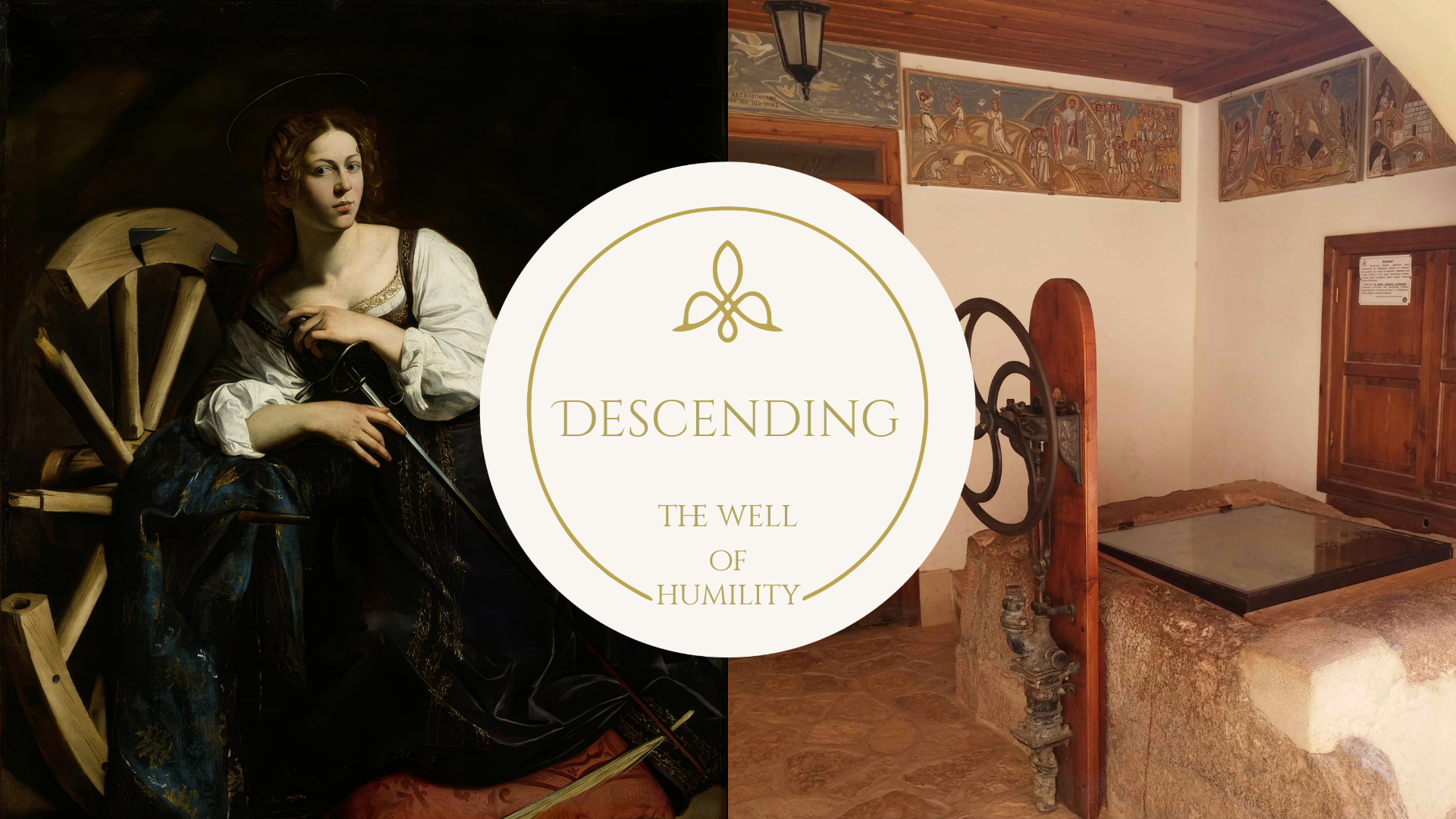
St. Catherine (left) pictured with a spiked breaking wheel and “The Well of Moses” (right) at St. Catherine’s Monastery, Mt. Sinai Egypt
A Christian Contemplative Series. Part I:
Cass and I recently spent a week in the Sinai Peninsula—part of it in a Bedouin camp in the desert, and part at St. Catherine’s Monastery, nestled in a valley at the base of Mount Sinai. It’s a fascinating place: a Christian monastery in a country that is mostly Muslim. The contrast alone invites reflection.
We hiked to the summit of Mount Sinai, along the “Camel Trail” and up the 3,700 “Steps of Repentance.” Near the top is a small cave where tradition says Moses received or wrote the Ten Commandments. The views were breathtaking. The people we met were generous and kind. The camels were hilarious. And the experience felt spiritually powerful—something about being there stirred the heart.
Yet as inspiring as the trip was, it left me with a question I couldn’t shake:
Have the Ten Commandments and other great stories of Abrahamic religion made us spiritually richer, or poorer?
See, I grew up as one of Jehovah’s Witnesses. If you’ve ever known someone who was, you know they take the Bible very seriously. As a child, my dad would read to me from My Book of Bible Stories before bed. The stories were dramatic—burning bushes, parting seas, pillars of salt. What calmed me wasn’t necessarily the content of the stories, but the sound of my dad’s voice. As I grew older, though, my faith became complicated.
The Bible describes a world where God speaks directly to people. Angels appear. Seas split apart. Food falls from the sky. Water turns into wine. God seems visibly involved in human affairs. But in any normal life, one doesn’t see that kind of divine intervention.
To me, Bible stories promote the sense that the people featured in the Bible didn’t need much faith—they got clear signs. Meanwhile, we are told we need “faith the size of a mustard seed” without any visible proof. A double standard, at least. As a teenager, I remember thinking, No wonder people say God is dead. If God wasn’t dead, it seemed like He had at least changed the rules without explanation.
That realization left me feeling disappointed, even a little abandoned. Why did they get visible miracles, but we don’t? Over time, I began to see this differently.
What if the burning bush wasn’t just about a magical plant literally on fire? What if it was a way of describing a profound experiential shift—a moment when someone encounters something deeper than ordinary reality?
Maybe the story isn’t about supernatural fireworks. Maybe it’s about high-energy states of consciousness.
Supremely exalted states of consciousness may explain the miraculous.
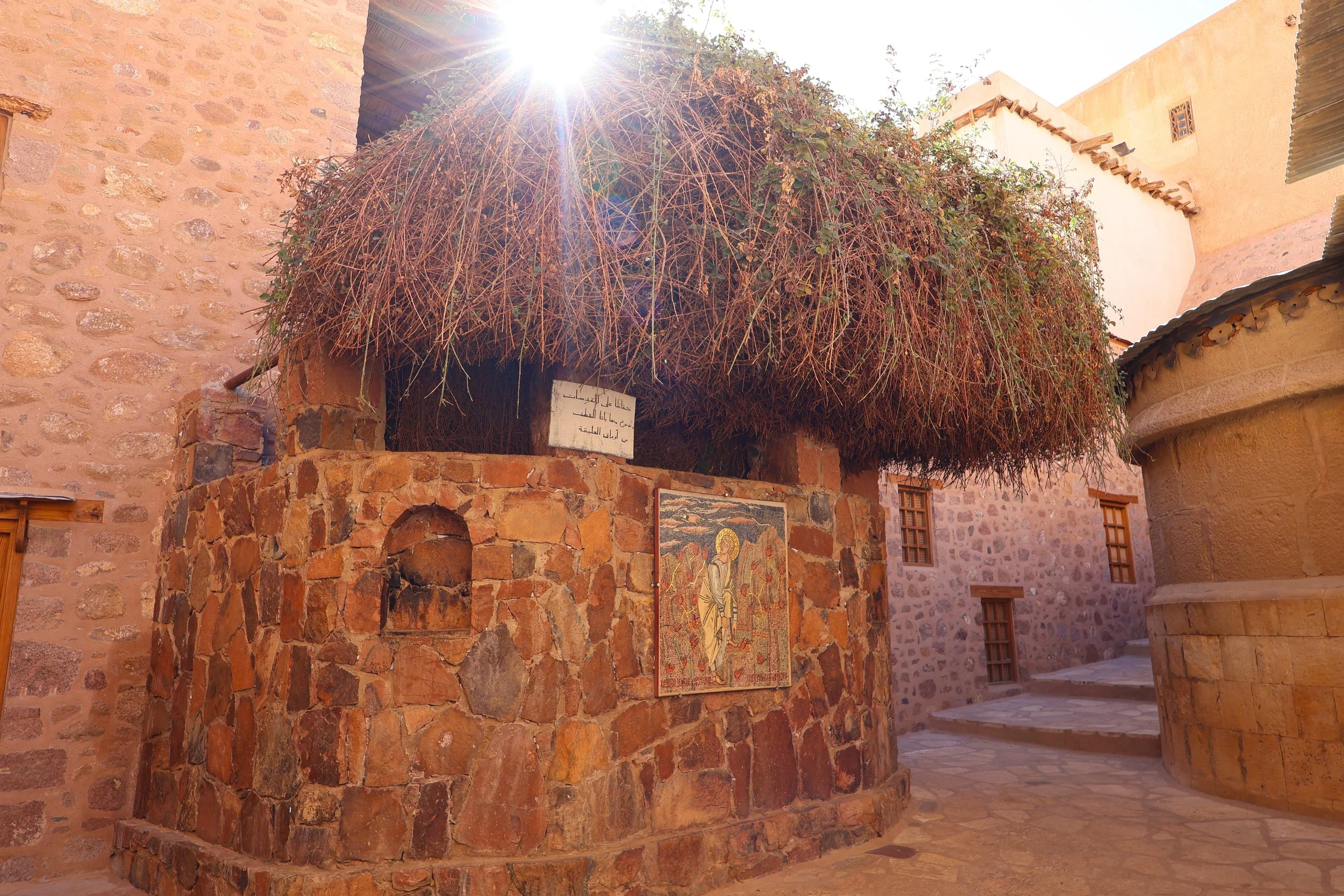
The alleged, actual bush that burned and spoke to Moses. St. Catherine’s Monastery, Egypt.
If you’ve experienced these high-energy states, you’ve likely realized they are a sort of consciousness orbit. I mean, even simple moods are a profound state shift. For example, if you’ve ever been genuinely depressed, it seems as if the depressed state of consciousness is all there is and all there ever has been. In mood states, what is true and apparent in one state is completely different than what is true and apparent in another and when we are in one we completely forget what its like to be in another. Or, as if that other state where we are seemingly capable of being permanently happy or sad no longer exists at all. Its reality is no longer available to our mind. It’s as if in one energy ring or orbit we can be in contact with Mars, on another, Earth, and another Neptune and neither Neptune or Mars’ reality is available while we are in in Earth’s orbit.
Magical realities such as what’s found in the burning bush story are at a higher energy orbit than normative orbits permit. How we get into these “burning bush” states are covered more within Relationship Yoga. For now, I think it's helpful to ponder the miracles of the Bible as internal high-energy states of consciousness instead of acts that defy the physics of ‘objective’ reality, which, if true, has significant implications on how you both create and solve the problems of your life. That is if we choose remembrance of what’s true in these higher states within the moments our egos flare.
“No problem can be solved from the same level of consciousness that created it.” —Albert Einstein
By affecting our experience of state of consciousness, metaphysical energy shapes our reality of what is real, what is true, and what is apparent. Understanding how to work with this energy is perhaps one of the greatest mysteries and important discoveries in human existence. It is perhaps singularly what has given the entirety of Yoga its unique effectiveness as a spiritual practice and as a wellness movement. High energy states—something we all have access to—are what enabled the genius of Christian Mystics such as Meister Eckhart and St. Catherine, not physical brain matter nor genetics. But, these exalted states, though they may be profoundly pleasant for you, they mean little for humanity if you don’t have a meaningful way to deliver their truth into the next moment of relating.
In the story of Moses climbing Mt. Sinai, he left us a powerful metaphor. Moses climbed the mountain to find silence, stillness, and solitude so that God’s “words” could be perceived. He transcended the valley of normal consciousness and realized some Truth. That message would have been lost to mankind if he had done like Yogis-of-old have suggested and clung to sustaining this transcendent state. Instead, he descended the mountain and brought with him a new way of living—a paradigm-shifting moral code—for us all to embody. He was willing to do the work of self-actualization—to, through embodiment, make real what God had shown him was possible.
As those who aspire to bring The Kingdom of God to earth, we must keep in mind that transcendence and ascending are equally important to inscendence and the descending movement. Yin is not more important than Yang, they are both parts of a whole. All meditation and no contemplation is like spiritual masturbation. All theory and no embodied action does not a heaven make.
Still, let’s engage a challenge the Old Testament presents: God almost always appears as an external force—something “out there” performing signs and wonders. Which logically can lead us to searching for God somewhere outside ourselves.
But Jesus introduced something radical to keep us on track. In Luke 17:21, he says, “The Kingdom of God is within you.” A paradigm shift which promotes turning our gaze away from looking for God in dramatic events, towards what lies inward. Jesus shifts the focus of the law. Rather than emphasizing rule-based obeisance, he summarizes everything into 2 commandments:
Love God with all your heart, soul, and mind.
Love your neighbor as yourself.
And one additional “3rd Great Commandment,” as it is contemporarily termed:
Love one another as I have loved you (John 13:34–35, 15:12, 15:17).
He says, “all the law and the prophets hang on these two,” which emphasizes how serious Jesus was about making sure we took in their gravity. So why do so many Christians and Westerners in general focus more on the Ten Commandments than on Jesus’ commandments? I mean, all of Jesus’ commandments are about Love and Love only, yet no one in the mainstream body politic are preaching or practicing a love like this. Maybe it’s because love is harder. It requires inner work. It forces us to examine ourselves.
Jesus told us where the kingdom is—within.
He told us what to do—to love. But he didn’t spell out exactly how. And that “how” becomes a lifelong journey.
If the kingdom is within, then spirituality is less about chasing external signs and more about cultivating an inner life. It’s about building a relationship with the deepest parts of ourselves—the part which is always, already the source of Goodness and the part which still seeks ruination, and getting them to meet. It’s a deep well where only presence and humility can go. The problem is that most of us are constantly distracted. Preoccupied by the surface of life, the appearances of what’s real and true, given our state of consciousness. Our attention is consumed by entertainment, social media, news, material pursuits, endless information. Our inner world is crowded. And when it’s crowded, we can’t hear the still, quiet, miraculous kingdom within.
Contemplation is how we compare and contrast our ego with the standards of the kind of Love Jesus commanded we embody. Contemplation a purification process, which often requires suffering by being self-honest regarding our ego. If our spiritual practice doesn’t include cultivating humility, getting in touch with our own darkness, we are left wandering in the desert of a self-deceptive spiritual fantasy.
In fact, there is an incredible existential riddle in Jesus’ commandments, if we examine them carefully. I mean, how could we possibly sustain loving God with all of our faculties—heart, soul, and mind? How could we survive such a love affair? There's only one way: presence.
Presence is the “master key” virtue that unlocks access to all of our greatest qualities and helps us to redeem our worst. Though, it is not sufficient in itself to become the Lover Christ extolls. It opens the door to virtue, but leaves us in charge as steward and cultivator over our own energetic and egoic fields of consciousness.
See, God is never an object of consciousness. God is consciousness itself. God could never be that which distracts us away from itself. God is always only available in the ever-present now and the only way to find God in order to love God completely is by being unoccupied by any finite object that blocks God’s infinitude (thought, emotion, resistance, clinging, position for or against something, etc.). Consciousness being aware of consciousness directly—stillness observing the ever-changing stillness. When we do this, we unlock one way to build metaphysical energy: through the act of perceiving infinity.
Infinity = God

Holding one mirror to another creates an infinite regress. The relevance of this concept is expanded in part III of this series.
God is the infinite spaciousness that flows into the vacuum created when our perceptual faculties are no longer filled with anything. Presence—the Now, is primarily just the lack of being occupied/preoccupied by any particular object of consciousness. Presence is where God’s miracles have been hiding from our minds.
How do you create this blissful lack of occupation, you might ask? By building a relationship with the subtle sensational reality of metaphysical energy and anchoring your awareness into its continual flow. The experience of this energy is the base substrate of consciousness—your quantum field manifest into a formless flow. It is what exists prior to thought, emotion, or other such forms. Like smoke or steam, a form which has no static shape, but can still be detected by the senses. Metaphysical energy is God’s most privative manifestation and is always available as a subtle sensation, as felt-sense experience. God is there waiting to greet you, like Moses, if only we would do the work of clearing out all the coarse noise distractions which block this still, subtle reality.
If you want to find God, this is the most direct way. If you want to Love God completely, and perceive your neighbor is also a part of this very lovable God, which is identical to the field of Love in yourself, you have to become the most present you can become. When you do, the Love Christ wants you to experience will naturally appear, effortlessly. The effort arrives not in loving but in staying present, using your will to remove the egoic blocks within yourself you’ve placed against the natural flow of this Love.
“Your task is not to seek for love, but merely to seek and find all the barriers within yourself that you have built against it” - Rumi
Love doesn’t come from mental effort alone. It comes from depth—from a place of stillness and awareness. But stillness requires space and if we never slow down, we never go deeper. The Prince of Peace is in the pause. The space between ‘what happens’ and our response to it. And this takes us from the mountain, through the valley to “The Well of Moses.”
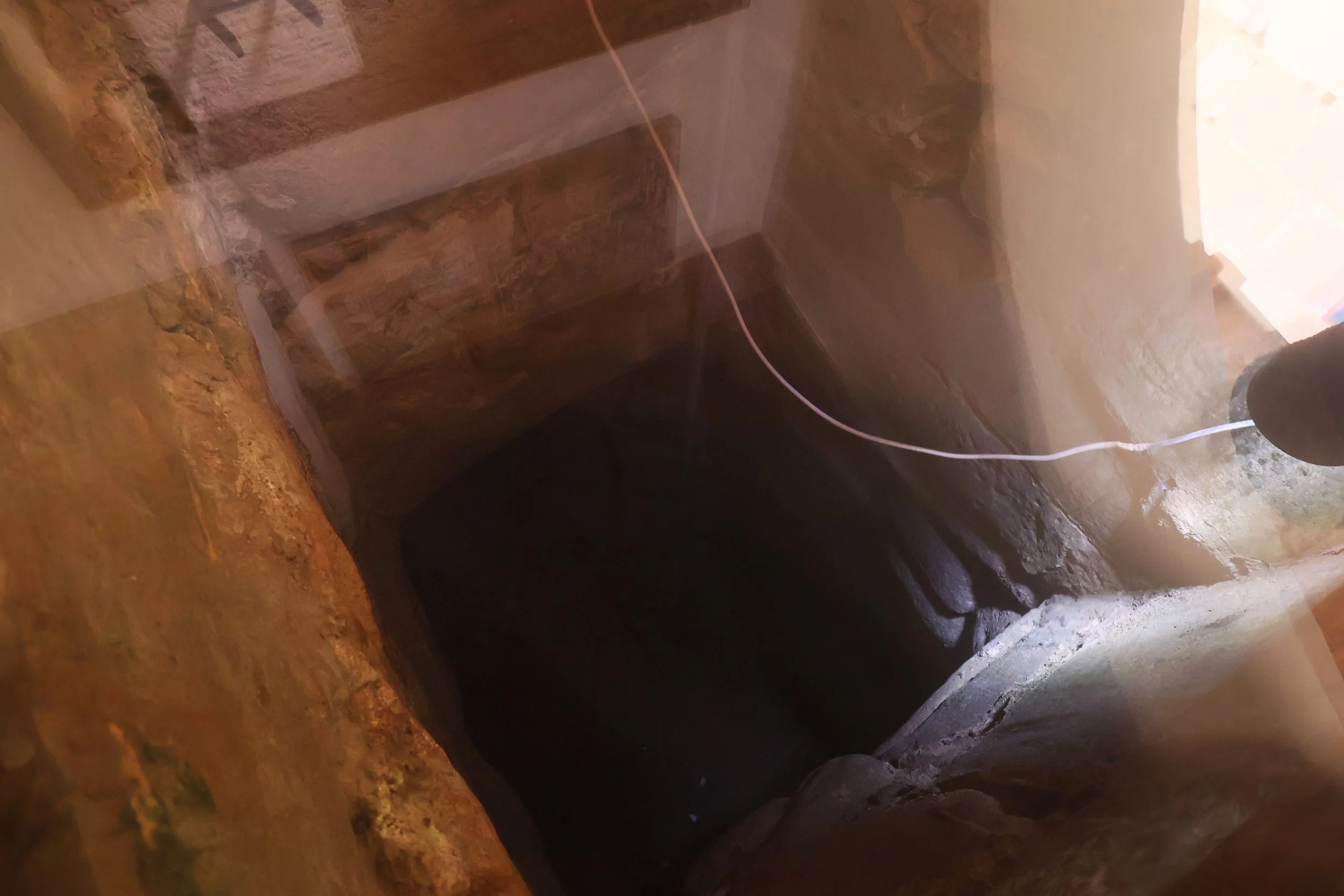
Moses’ Well, which still provides abundant water in the middle of a very dry desert: St. Catherine’s Monastery, Egypt
Imagine your inner life as a well.
At the top of the well is the idea of loving your neighbor.
At the bottom is the inner work required to actually do it.
To draw water from a well, you have to lower the bucket. That takes time and intention.
In this metaphor:
Humility is the rope that lowers the bucket.
Emptiness (freedom from distraction) is the space that allows it to fill.
Presence is what gathers the water.
At the bottom of the well are our unresolved wounds, insecurities, and inner conflicts. When we avoid them, they shape our behavior from the surface. When we face them with the light of our awareness and the metaphysical energy of our higher self, we grow in compassion, empathy, and loving kindness in all dimensions. Real love is born from self-understanding. The more honestly we confront our own pain, the more capable we become of loving others.
If we never go beneath the surface, we stay reactive—living from habits, impulses, and ego. But when we create space within, something deeper can emerge. Call it conscience. Call it spirit. Call it God. Whatever you want, but it’s our only source of authentic Truth.
When we live from that depth, we don’t need an external list of rules to tell us how to behave. Love flows naturally, if we know how to get out of the way. Ethical commandments are like training wheels—helpful, but not the final goal.
The deeper goal is transformation: self-realization and self-actualization. So the real question becomes:
What occupies your inner world each day?
Is it an intentional part of a contextual web of goodness, truth, beauty, and love found in presence? Or is it constant, random distraction? Are you listening to that true crime podcast because it helps you transmute the darkness within and grow in compassion? Or is it more about avoiding what arises in the still spaciousness that lies just beyond the horizon of boredom?
The outer world—science, material things, measurable reality—is finite. But your inner world has a different quality. It’s expansive. It is the source of goodness itself. Like God, it is infinite, and if we’re willing to dive into the interior space of infinity, the potential to bring new infinite possibilities to the surface is born.
The space between thoughts—the pause before reaction—is where transformation happens. In that gap, something wiser can emerge.
Maybe the miracle stories of the past were pointing to this all along. Not to magic “out there,” but awakening “in here,” which is where miracles appear as shifts in our perspective. And perhaps the greatest commandment—not only to love but to Love—can only truly be lived when we are willing to create the space within for the kind of “Love that loves to love” to arise.
If we were to treat our bodies as a temple, could we leave all that clutters our experience of presence right outside the temple door? If we want to experience Divine Union with our partner or neighbor, we have to be willing to let go of our preoccupation with objects so that we can attend purely to the Divine in them with the Divine in ourselves. When presence meets presence, Love is all there is.
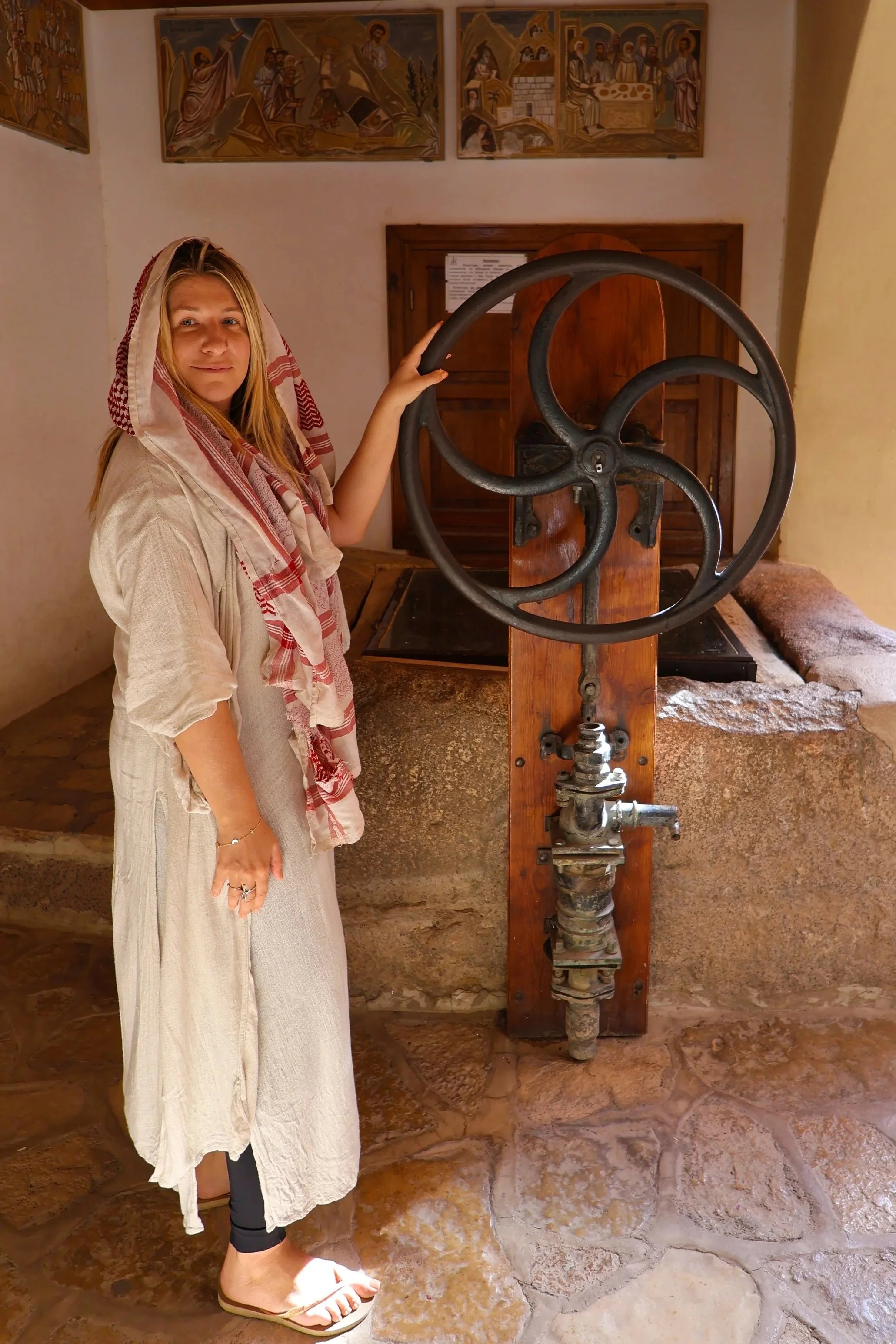
Cassandra at Moses’ Well: St. Catherine’s Monastery, Egypt
