Part II: Ascending the Ladder of Virtue
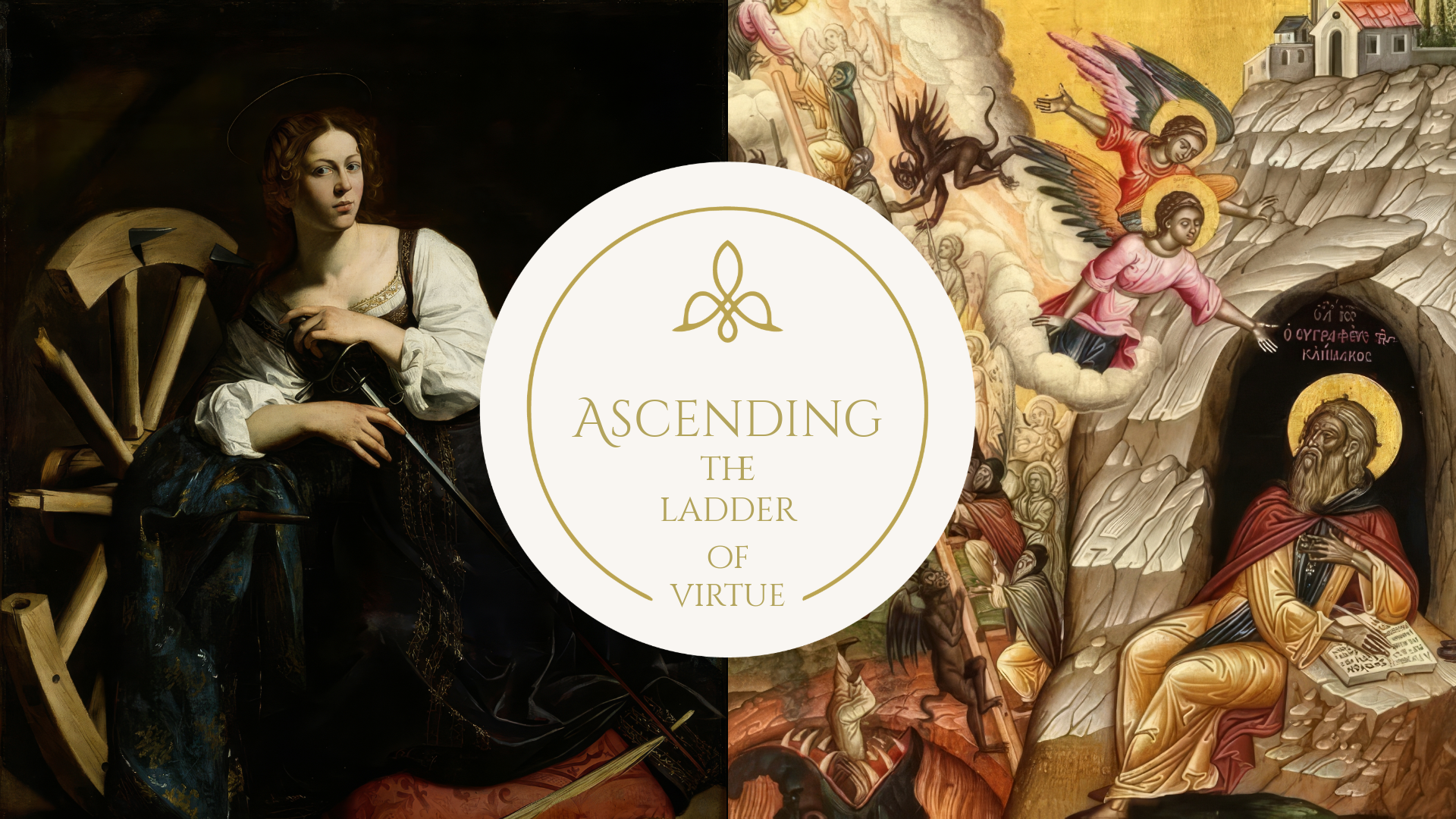
Left: Saint Catherine pictured with the spiked breaking wheel and sword in hand. Right: a painting of St. John Climacus (c. 579–649), Abbot of St. Catherine’s Monastery, along with an illustration of his great work “The Ladder of Divine Ascent” (Scala Paradisi).
A Christian Contemplative Series. Part II:
The sun was setting over the Sinai desert. Silence was the loudest sound that could be heard. The wind was the only thing that wasn’t completely still. Cass and I were discussing occupation. Not the imperialistic kind, though we discussed that a few days previous to this one. The lack of occupation and preoccupation of ourselves and it felt like fine art as it settled us beautifully, calming our systems.
Through the moment’s still contrast we realized how much the occupation of our energy bodies affect our wellbeing and sense of peace. That, combined with the preoccupation of our minds with objects of distraction had been likely symptoms of some dissociative ungroundedness—induced by a traumatic first few days in Giza. Travel tip: don’t go horseback riding around the pyramids.
Amidst a backdrop of this calm clarity we made our way to St. Catherine’s Monastery. The mysterious story of Moses and the talking, burning bush was burning a hole in my mind. I pondered: How do we know when we are in authentic transcendent states which are a part of Vertical growth—perceiving higher Truth—or just in a state of delusional hallucination? And how do we bring what is realized in transcendent states into our normal lived experience?
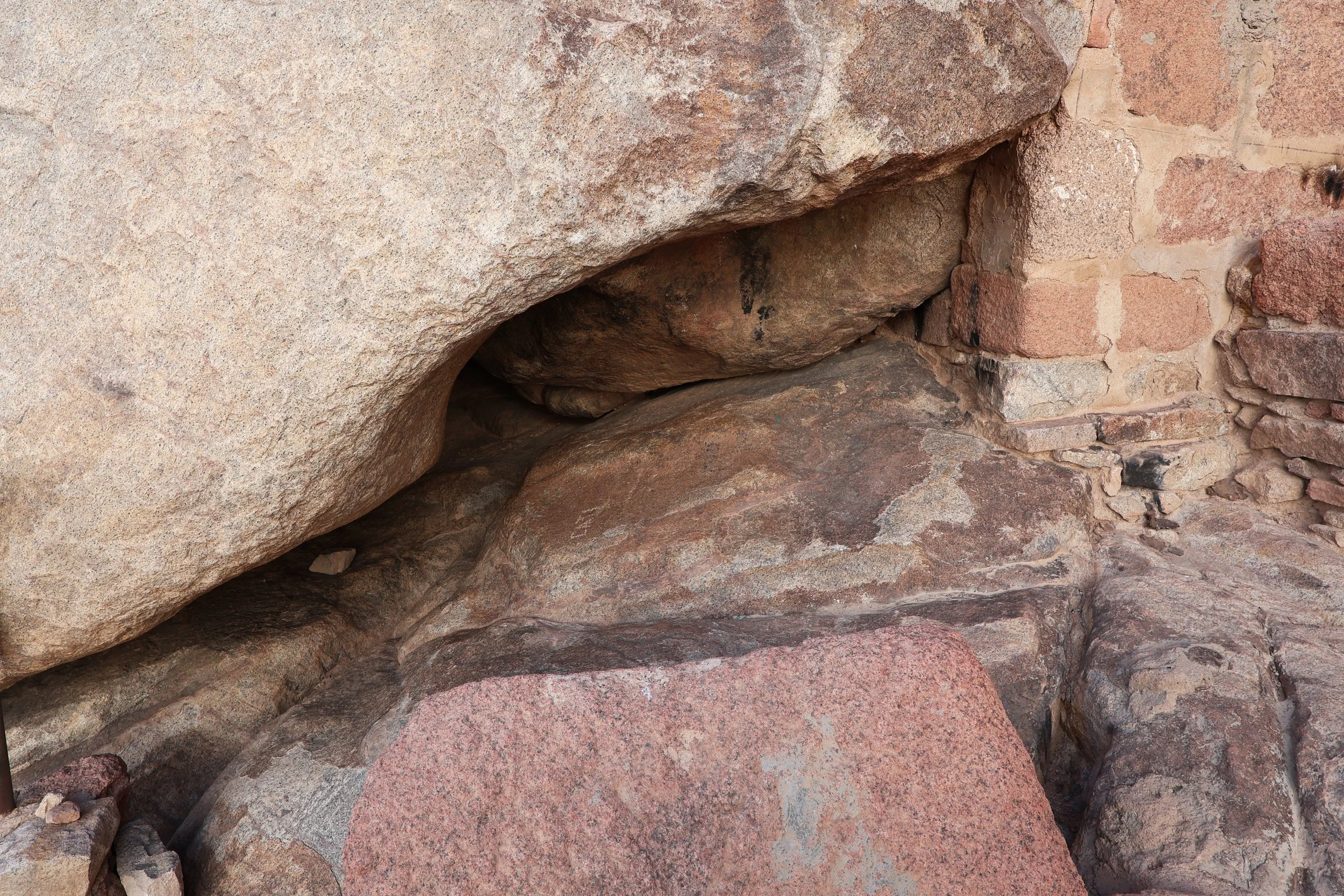
The alleged, actual cave Moses wrote the Ten Commandments in. St. Catherine’s, Mount Sinai, Egypt.
St. John Climacus (c. 579–649), Abbot of St. Catherine’s Monastery on Mount Sinai thought there was a method beyond any madness. He authored "The Ladder of Divine Ascent" (Scala Paradisi), a foundational 7th-century ascetic treatise on spiritual growth. Inspired by Jacob’s Ladder, it outlines 30 steps of virtue and vice mastery, mapping the soul's journey toward God. Depicted in this iconic work is a ladder showing monks ascending toward Christ, while demons try to distract them and holy angels assist their focus on ascent.
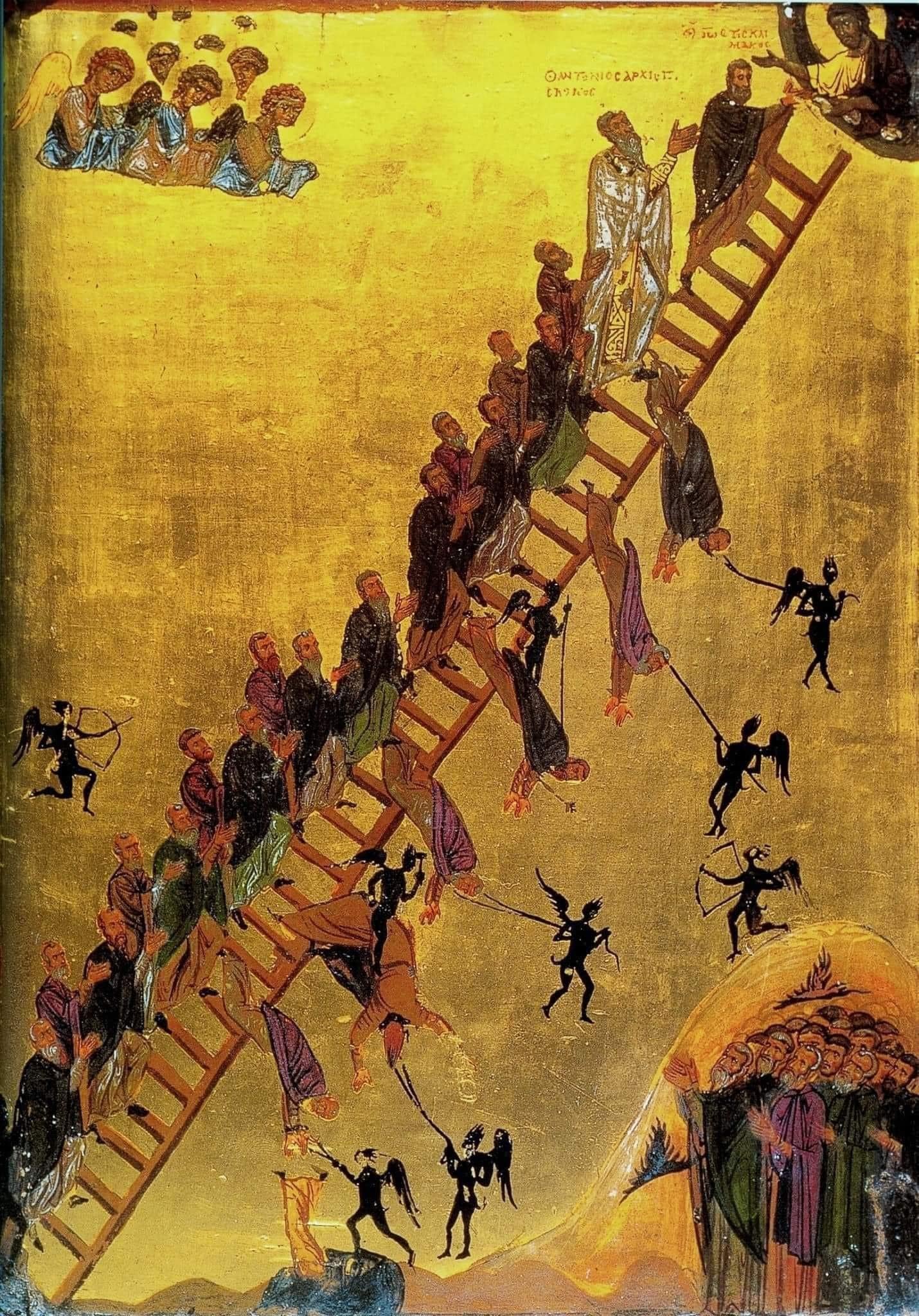
St. John taught renunciation, detachment, and the cultivation of virtues like humility, silence, and love were the path. Becoming a being possessed by such qualities is how we ascend the ladder and his work on the subject is considered one of the most important texts in the Orthodox tradition, particularly for Hesychast, monastic, and contemplative practices.
Cass and I saw this ladder scene painted into several pieces of artwork and Bibles on display at the monastery, which we weren’t allowed to photograph, but upon seeing them I was delighted to be reminded of early Mystical Christianity’s focus on virtue. In my experience, Buddhism and Mystical Christianity are religion’s most robust paths for providing written works focused on cultivating virtue. Regarding virtue, the Buddhists seem to doing just fine but it seems many Christians today have long left virtue cultivation in the rear view since the body politic of right-wingedness overtook their views on “the good the holy.” Helped in-part by doing a deal with the devil—installing a demagogue strong-daddy in a moral position above Christ, in order to quell the fears propagated by Fox News. Though the bible is unambiguous regarding installing a worldly authority over one’s life:
Matthew 23:9 - “And call no man your father upon the earth: for one is your Father, which is in heaven".
Contextually, Jesus is using hyperbole to warn against prideful, self-exalting leaders seeking honor rather than forbidding the respectful use of "father" for biological parents or, in some interpretations, spiritual mentors. This verse is part of a broader critique (Matthew 23:1-12) where Jesus condemns leaders who love titles and demand honor, urging his followers not to follow their example. The focus is on supreme spiritual authority. Jesus emphasizes that God alone is the ultimate source of life, truth, and authority. While literal, this instruction is also a warning against letting any human authority replace or overshadow God’s authority. In the same passage, Jesus also extolls us, "do not be called Rabbi" and "do not be called instructors," reinforcing that He is the only ultimate teacher and leader.
Do you know many Christians today that are sanely working on worldly detachment and virtue cultivation? I for one haven’t seen any noble examples of ‘Trump Christians’ claiming the love of their neighbor is the highest teaching. And if you’re into Trump be honest with yourself, are you more hateful or loveful now?
I see today’s Christians cultivating vice as virtue: inviting a true hate for their neighbor, which is exactly the opposite of one of Christ’s only two commandments. In fact, it's reported that evangelical Christians see Trump’s viciousness as a virtue rather than a vice. Virtuous so long as it is employed against those they perceive as their enemies—against those whom they resent and for whom they have a seething hatred. To place the teachings of The King of Kings in the back seat to the pronouncements of the king of Mar-a-Lago is a clear estrangement from God’s standard of goodness. Do you really think mirroring Trump’s “virtues” places you on the side of Christ? I digress.
I don’t even see many New Earth New Agers applying themselves to become a living example of Christ's commandments when aspiring to embody “Christ Consciousness.” I for one haven’t found any courses on Mindvalley advertising ideas such as “Become as Virtuous as a Monk” though it is objectively verifiable through countless NDE accounts that what our Souls care most about isn’t the ability to manifest. Not in the power to become a succesful fabulist guru. No, what matters in the end is the less marketable, less woowoo stuff: how we’ve treated others while on earth, which is only ever equal to the virtues we’ve embodied such as kindness, compassion, humility, honesty, etc.
Instead of virtuousness, in the west, spiritual materialism, abundance culture, alien conspiracies, self-benefit magic, and law of attraction ‘rank selfishness-in-disguise-as-spirituality’ seems to have taken over the minds of spiritual aspirants. A kind of spiritual impoverishment owed in-part to the backlash sprung against Abrahamic religions. Delivered justifiably in response to religion’s rank corruption.
Both contemporary movements—Christianity and New Agism—seem to believe magical thinking and wishful prayer alone, which ignores personal change, is sufficient to ascend. But, if you’re a Christian, what about James 2:17? "So also faith by itself, if it does not have works, is dead.” The passage expresses that true, saving faith naturally produces virtue; manifested in good actors who naturally manifest good deeds. Serving as evidence of a living relationship with God, rather than merely verbal or mental assent.
New Agism has accomplished important improvements as a post-modern disruption of religious paradigms, but unlike religion, it lacks its own philosophical ground. In New Agism, it seems anything goes and whatever your subjective truth is, it is treated as equal to objective Truth. That conflation is as problematic as our collective history of witch trials. Love, Goodness, and Truth exist as an unchanging aspect of consciousness which isn’t subject to our opinions or how many cord cutting ceremonies we’ve done. If our philosophical ground isn’t woven from the threads of our direct inner connection to the Divine Virtues, we’ve lost perhaps the most valuable aspects of religiosity: being bound to embodying heavenly principles, living morally, and having an appreciation for our conscience, not just our consciousness.
Meditation is transcendent/ascendent in nature while contemplation is inscendent/descendent. Regarding our greatness, meditation shows us what is possible. Contemplation, the work of bringing that greatness into ourselves as an integrated whole being. We transcend the ego not to learn to remain transcendent but to bring the ego into alignment with this meditatively revealed standard of greatness.
So why have we strayed from virtue as the focus of spiritual ascension? Why hasn’t Jesus been sufficient in convincing us to live as a citizen in The Kingdom of God on earth? And how to live the commandments that will help us obtain it? I believe the answer lies not in Christ’s lack in any way but in the modern “sin” I wrote about in part I of this series. Not a sin one can find in the Ten Commandments, but an important one to consider nonetheless: the sin of preoccupation.
Preoccupation with money, selfish manifesting, the next shiny object, distraction, or new experience for example. We can’t love God with our whole mind, heart, and soul if we are preoccupied with something other than manifesting the virtues of Love.
The Egyptian Muslim majority culture seems to be preoccupied with the importance of covering women’s hair over cultivating the virtue of Love. To me, a clear sign of a religion that, like Christianity, has strayed from its core virtue cultivation and will end up misleading more than providing a helpful path of ascension. This covering of hair is no different to me than prioritizing politics over personal change—both hair and political obsessions can be unhelpful preoccupations. A spiritually useless distraction away from the challenging personal work it takes to become loving citizens of The Kingdom of God, which requires incredible contemplative devotion.
Though I admit it seems unstimulating at first, we should all concern ourselves with the question of virtue. In light of all we know about our collective leaning into environmental catastrophe, AI-induced job loss, rank political corruption, late-stage capitalism’s failures, etc., we should be concerned not with our Instagram follower numbers but with the fact that we are all about to meet with an incredible zenith of a meaning crisis already underway. Is your spiritual practice grounded strongly enough to bear the burden of such pressures?
Or, is there an even more important question to answer: are we in the prophetic ‘end times’? One read of the book of Revelation and how it describes the conditions that precede the establishment of “a new heaven and a new earth” has me convinced. Whether or not one believes we are, isn’t it potentially more helpful than harmful to act as if we might be? To consider our moral character, our virtue cultivation, and how strong or weak we might be in regards to withstanding great catastrophe might be just the right aim to correct our meandering into a deeper meaning crisis.
The only real currency of the future isn’t in Bitcoin or even gold. The only enduring asset that will stand the test of time is the economics of how successfully you traded in the treatment of others in this lifetime. How you treated others—measured in love, actualized—is the only currency that you will take with you when you pass out of the illusion of spacetime into what is more permanent, what is actually Real. Are you investing?
If you take this contemplation seriously, you may come to the same conclusion that myself, St. John Climacus, Friedrich Nietzsche, and others have arrived at. That is this: what will matter most when the matrix institutions of meaning-making come crumbling down, when resources are scarce and things turn desperate, what will matter most won’t be your political hatred or your skillfulness at manifesting the wheel of capitalism to spin toward your favor. No, what will matter most is power.
Not power over people or processes. Power over yourself.
The power to command virtue over vice, good over evil, greatness over victimhood—within yourself.
What will be worth more than money when war, corruption, nihilism, and nature’s upheaval ravages most all that we currently take for granted will be a spiritual power—the power to be able to choose non-suffering. The power over being personally corruptible or incorruptible, when the shit hits the fan. The power over your ability to avoid becoming what you hate, or to avoid becoming hateful when people around you become desperate. What protects your soul—what your soul cares most about—is the condition of your metaphysical heart. What protects the purity of the condition of your metaphysical heart is how much virtue you’ve cultivated within yourself and the power to withstand the corrupting force of vice—demons and the Satan, if you will.
Virtue or vice, both are born within and are borne by the heart.
The Bible highlights the heart as the source of actions, thoughts, and spiritual condition, urging believers to guard it diligently as it determines life's course (Proverbs 4:23). The following scriptures focus on maintaining a pure, soft heart rather than a hardened one, emphasizing that God examines our inner condition.
Proverbs 4:23 (NIV): "Above all else, guard your heart, for everything you do flows from it".
1 Samuel 16:7 (NIV): "...The LORD does not look at the things people look at. People look at the outward appearance, but the LORD looks at the heart".
Psalm 139:23-24 (NIV): "Search me, God, and know my heart; test me and know my anxious thoughts".
Matthew 12:34-35 (NIV): "...For the mouth speaks what the heart is full of".
Ezekiel 36:26 (NIV): "I will give you a new heart and put a new spirit in you; I will remove from you your heart of stone and give you a heart of flesh".
Psalm 51:10 (NIV): "Create in me a pure heart, O God, and renew a steadfast spirit within me".
Matthew 5:8 (NIV): "Blessed are the pure in heart, for they will see God".
Are you strong and powerful regarding your ability to care about and cultivate virtue? Or, are you strong and powerful in your ability to make yourself comfortable? Do your spiritual skills include an ability to remain unconditionally equanimous when faced with great discomfort? Or, are you dependent on a strongman leader or guru for your clarity and resolve? Do you care about how taking responsibility or lack-there-of affects the others in your life? Or are you too busy with magical thinking to do the hard work of ego development? Perhaps the “Year of the Fire Horse” is about building a relationship with the steadfast guru or God within? If fear or hate has taken up residence in your heart, who’s going to save you from yourself?
If you’ve struggled to cultivate virtue and overcome self-sabotaging patterns in your life, finding a spiritual partner—someone that motivates putting something at stake greater than yourself alone—can truly make all the difference. There’s something to being accountable to someone, for someone’s happiness, wellbeing, and ultimate destiny that genuinely changes our motivational energies and capabilities. Almost to the extent that, doing this high-level work on one’s own makes actualizing our greatness improbable to achieve. Not that it can’t be done, but I want to encourage you to consider that some work is exponentially more difficult to achieve when one is on the outside of being a responsible member of a community. May that community be a monastery, a family of your making, or a community of two: an intentional spiritual partnership. To learn more about how to build Spiritual Partnerships, visit Relationship Yoga.
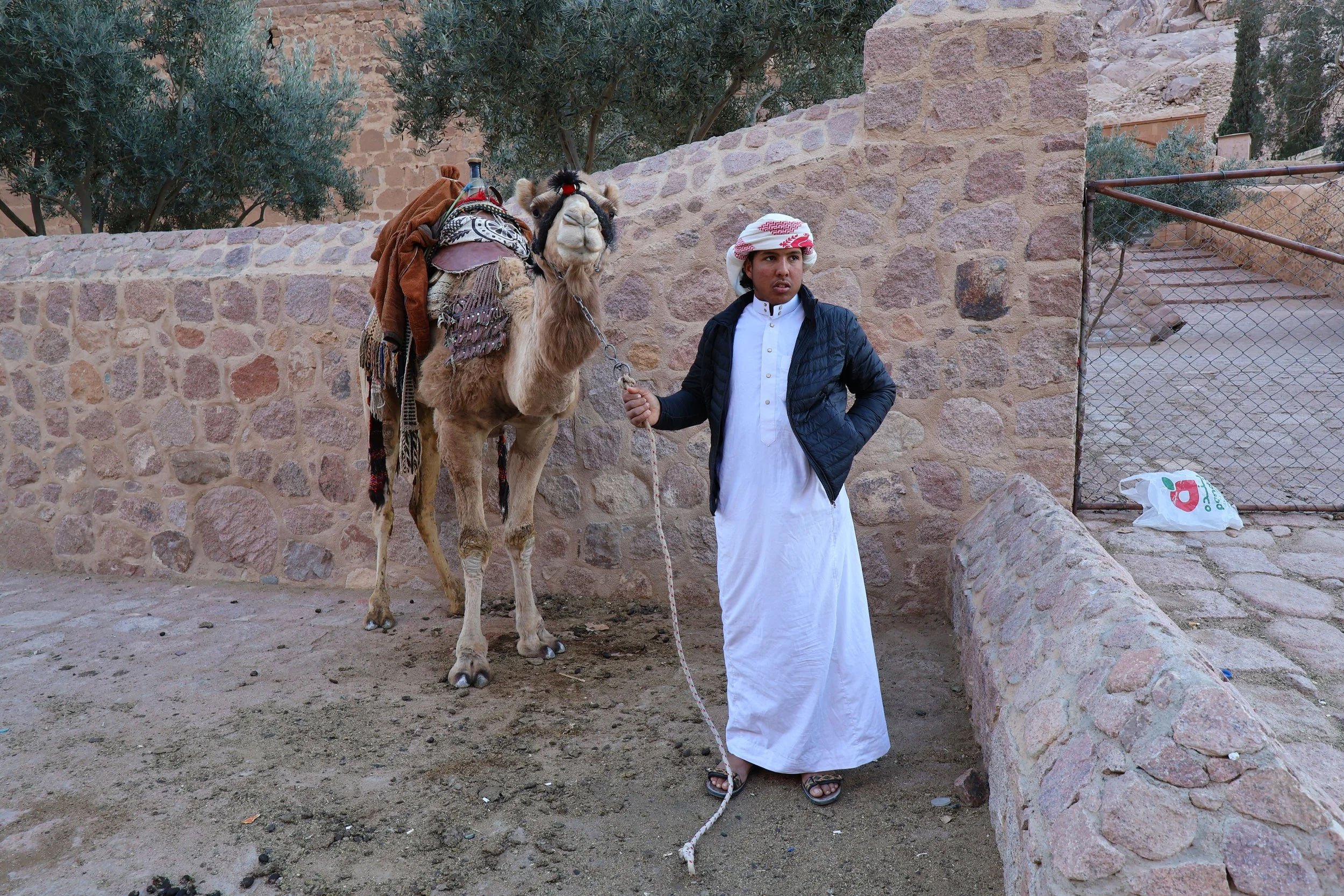
A community of two: a kind Bedouin (age 17) and his camel (age ?), whom he’s accountable to.
